The Stephanie H. Shaw Scholarship recognizes a female graduate student in the Polymer Program for their scholarly activities as well as community contributions. The Scholarship is named after Stephanie Shaw, the beloved “mother hen” of the Polymer Program during the 1980’s, who perished in an accident while hiking in Europe.
This year the Polymer Awards committee recognizes Marina Dabaghian for her research in multifunctional nano-coatings, patent award in nanocoating processing, and efforts in student mentorship. Marina has been a great contributor to The Sun Group, under the guidance of Distinguished Professor Luyi Sun.
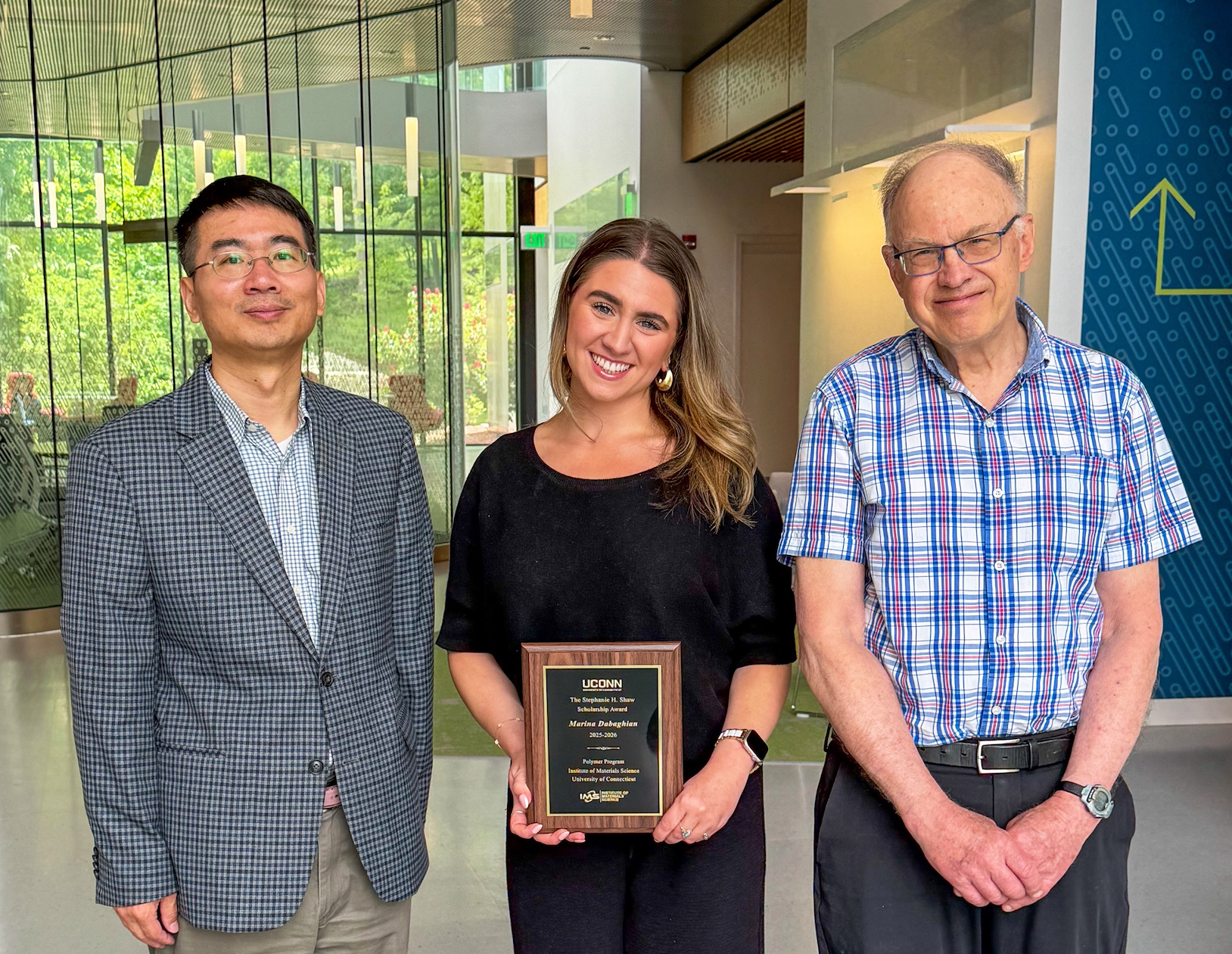
Prof. Luyi Sun, Marina Dabaghian, and Prof. Emeritus Monty Shaw
Research excellence with clear impact: sustainable packaging and dielectric energy storage. Marina’s doctoral research centers on developing innovative multifunctional nano-coatings with demonstrated relevance to sustainable packaging and energy-related materials, areas that are both scientifically challenging and important for our planet. She has advanced biomimetic polymer/clay nanocomposite coatings created through flow-induced self-assembly, emphasizing scalable processing, and green chemistry principles.
A hallmark of Marina’s work is her ability to improve performance while thoughtfully addressing sustainability constraints. She investigated citric acid as a more sustainable crosslinking alternative in polymer/clay systems, aiming to replace conventional crosslinkers while preserving barrier and mechanical performance. She also designed polymer/clay nano-coatings for paper-based compostable food packaging, achieving strong mechanical and gas barrier properties—work that speaks directly to urgent needs in circular materials and sustainable product design.
Equally impressive is Marina’s contribution to advanced dielectric materials. She engineered high-performance nano-coatings for dielectric energy storage films, achieving improved corona resistance and electrical breakdown strength, a technically demanding space that requires careful structure–property control and rigorous validation. Her contributions are reflected in peer-reviewed scholarship, including a publication in Nano Energy, High-Temperature Dielectric Energy Storage Films Featuring Self-assembled Hot-Electron Blocking Nano-Coatings.
Demonstrated translation and scalability: bridging lab innovation and real-world manufacturing.
Marina has also shown how rigorous polymer science can translate to practice. She helped validate industrial scalability of polymer/clay nanocoating processes through pilot-scale roll-to-roll coating trials in collaboration with industry partners. This reflects an ability to connect fundamental polymer physics, coating process control, and manufacturability—skills that define high-impact polymer scientists and engineers.
Her innovative contributions extend to intellectual property as well. She is a co-inventor on a U.S. patent (US 12,187,917, January 7, 2025), focused on biomimetic hybrid nanocoating compositions and methods of use. This combination of publications, patent activity, and scale-up experience underscores not only productivity, but also originality and relevance—qualities that align strongly with the purpose of this scholarship.
Scholarly activity beyond research: mentoring, leadership, and building community.
One of the most compelling aspects of Marina’s candidacy is her consistent, high-quality contribution to the academic community beyond her own research output. She has managed a team of 10+ undergraduate researchers, developing structured training protocols and fostering a collaborative environment that strengthened both lab productivity and student development. She mentors students through safety and experimental rigor, teaches strong documentation practices, and helps students interpret results with confidence.
Marina also served as a Graduate Project Manager for a senior capstone design effort, mentoring undergraduate engineers through compost ability testing of polymer/clay-coated PLA films.
Teaching and instruction: excellence in the classroom and student support.
Marina’s commitment to education is equally strong. As a Graduate Teaching Assistant, she implemented collaborative learning strategies to deepen students’ conceptual understanding and problem-solving ability, while also providing extensive and consistent academic support. Her efforts were recognized for her excellence in teaching through a Chemical and Biomolecular Engineering Department Teaching Assistant Award (2022 Spring).
Marina Dabaghian is an outstanding member of the UConn community. Her record reflects the rare combination of impactful polymer research while supporting other students through mentoring, teaching, and laboratory leadership.
Congratulations!