Each year the Polymer Program presents the Samuel J. Huang Student Research Award to a graduate student for outstanding research in the field of polymer science and engineering. This year, the honor goes to Xiaoting Xue who has completed her 3rd year in her Biomedical Engineering Ph.D. program under the advisement of Dr. Yi Zhang.
Xiaoting has been leading 2 research projects. The first was an unfinished project focused on developing advanced encapsulation materials for flexible implantable bioelectronics operating in chemically harsh environments. Implantable electronic systems must function reliably in complex physiological conditions containing water, ions, and reactive species that can degrade materials and cause device failure. These challenges are particularly severe in organs such as the gastrointestinal tract, where devices encounter highly acidic conditions. This was a project left unfinished by a senior graduate student who completed the program. Xiaoting took over during her first year in the graduate program and produced outstanding results which led to a publication in Nature Communications.
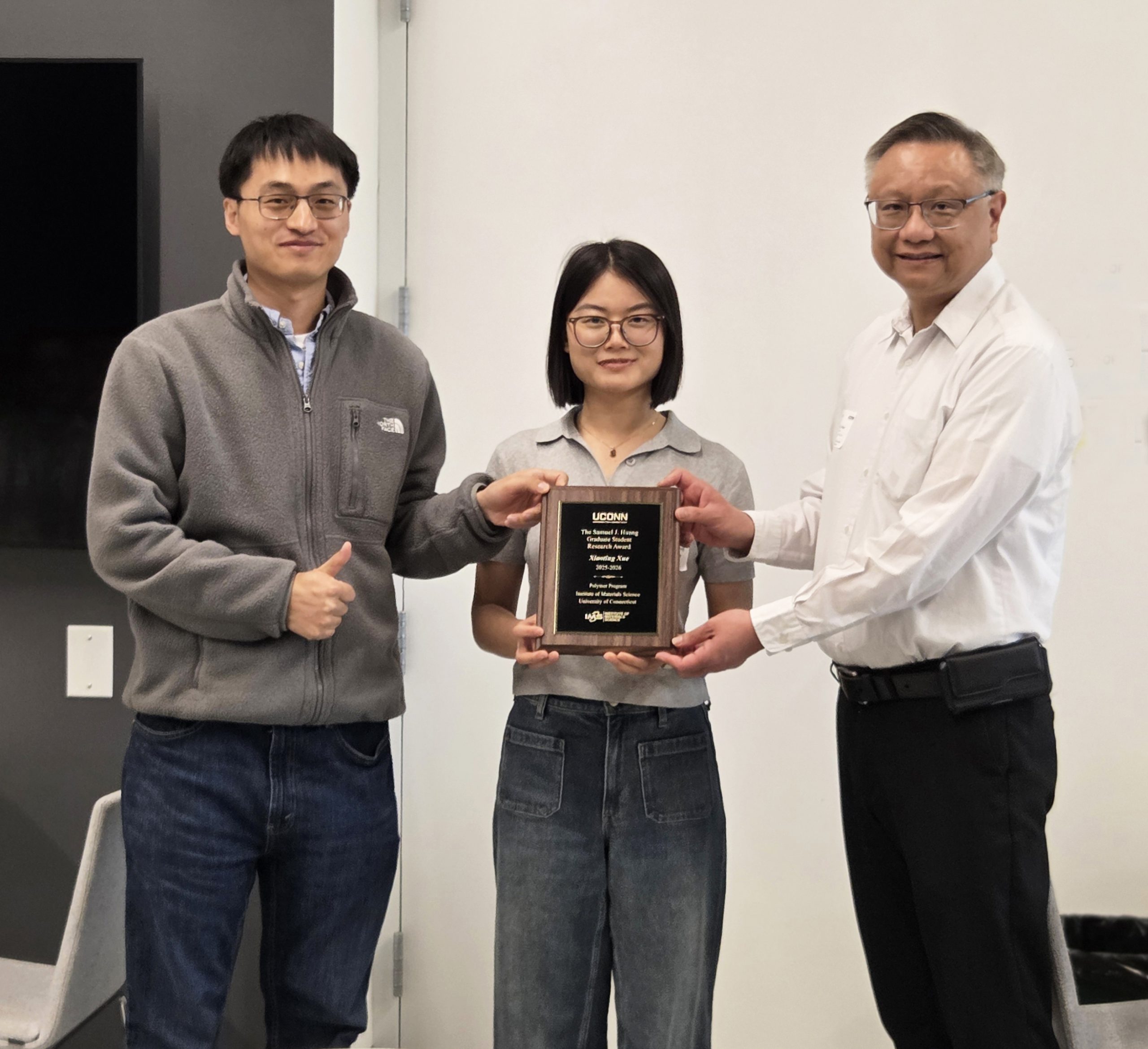
Prof. Yi Zhang, Xiaoting Xue, and Prof. Mu-Ping Nieh
Xiaoting’s second innovative research project focused on microfluidic devices for microsampling of neurochemicals in the brain. Accurate measurement of neurochemicals is essential for understanding neuronal signaling and neurological disorders, yet conventional techniques such as microdialysis often suffer from limited analyte recovery and temporal resolution. To address these challenges, Xiaoting developed a liquid crystal elastomer (LCE)-based push–pull microsampling system that enables programmable fluid manipulation through mechanically driven actuation. The device integrates a thermoresponsive LCE actuator, microheater, microfluidic channels, and 3D-printed components to actively deliver artificial cerebrospinal fluid and collect extracellular neurochemicals. By incorporating iron microparticles into the LCE matrix, she created an LCE/Fe composite actuator capable of efficient electrically driven actuation. When heated above the nematic–isotropic transition temperature (~83 °C), the actuator undergoes reversible deformation that drives fluid transport within the microsampling system.
Through careful device design and characterization, Xiaoting demonstrated reliable actuation and efficient fluid manipulation, with push efficiencies above 75% and pull efficiencies above 85%. The system was further validated in vivo, where implanted devices successfully collected extracellular samples from the brain and enabled detection of 21 neurochemicals using LC–MS analysis. This work establishes a membrane-free and chemically stable microsampling strategy that avoids gas-generation reactions used in conventional push–pull systems and represents a promising platform for next-generation neural interface technologies. The manuscript based on this work is currently in preparation.
In addition to having strong research and collaborative skills, they also serve as the lab’s safety manager. They have the self-motivation and leadership skills to keep the lab and instrumentation running smoothly.
Congratulations!